

As band directors, it is perfectly normal to have a moment of panic about the way your ensembles sound. Do they sound clear, transparent, and characteristic, or does it sound more like the cafeteria at lunch? If yours is more the latter, do not panic! There is still enough time for you to do something about it!
Here are some steps that I take to make my ensemble sound more mature in daily fundamentals and subsequent musical moments. These ideas can be applied to ensembles at any ability level, from beginners to high school ensembles.
What do you want your ensemble to sound like?
While the correct answer is always The Chicago Symphony, remember that those professional musicians once had to start somewhere. They too were once beginners! Nothing can replace us as directors taking on the responsibility of knowing how to help students create a clear and characteristic sound on their instruments. You must carry that responsibility of crafting that individual sound through their years in performing bands in middle school and high school - it never stops after the beginner year.
Our profession is filled with incredible teachers that are maximizing what young players can achieve on a daily basis! Even if their teaching situation is different from yours, there is always a process and structure in place that is guiding them to the end game. We can all find clarity at different levels with the students in front of us if we know what we are aiming for, but we cannot fix what we cannot hear.
It can feel frustrating when a clinician or judge tells you that your group is performing a piece or section that sounds noisy… What does that even mean?!?! There could be several reasons the sounds are hitting their ears in that way, so you have to diagnose. Here are some thoughts and indicators to guide your listening:
NOISY 🌪️
- Intonation - This can be very distracting if not monitored.
- Matching Volume - Same volume within a section and across groups.
- Section Balance - Can’t tell who has the melody v. accompaniment.
- Articulation & Style Alignment - Students must interpret it the same way throughout the music.
- Tone Qualities - Are students so wrapped up in notes, rhythms and tempos that they are not maintaining a beautiful and tonally centered sound on every note they play? Find ways to describe how you want each instrument to sound, and use those words as often as you can and in as many different ways as it takes for all students to understand.
CLEAR 🌈
- Alignment - Is everyone moving together and knows how their parts fit together?
- Transparent - Can you hear all of the individual instrument colors playing?
- Resonant - Is the correct amount of air and air speed used to create the optimal vibration on every note?
- Balance - Is it clear to the listener what you want them to hear at any point.?
- Colorful - Intentionally-balanced musical lines where it’s evident that there is a primary instrument in each line of instrument, even with other instruments playing along. Is this happening in every phrase?
Strategies and rehearsal techniques to achieve that sound through ensemble fundamentals
If your band is anything like mine, here every February we are in “teach like your hair is on fire” mode trying to get the kids to meet their timeline with rehearsal prep, split groups, pass-offs, and making sure we can get to that first performance with confidence and smiles on our faces. Oh… and let’s also throw a winter snow storm in there as well just to spice things up!
The truth is, the timeline is predictable, so you have to invest time earlier in the school year to establish a baseline of how you train the students to have an organized approach to listening, balance, individual skills, and procedures to make the later part of the year go smoothly, even when the unexpected shows up. They should be able to fall back onto their training!
Ask any great band director what their daily drill routine is and you will find a variety of intelligent and creative options for helping kids to improve on both individual and ensemble skills. These will all vary in depth depending on the level of ensemble you teach, but there are some universal truths to what everyone is ultimately trying to establish. You are trying to create a baseline in their ear of what you want them to sound like so they can transfer that skill to the music.
Start with a Concert F every. single. day.
All of our rehearsals start with a concert F exercise. The priorities are establishing eye contact, breathing together, consistent note starts, sustaining energy, and the sound touches silence. This one note can be the venue to establish exactly what you want your group to sound like. For most instruments, it is in the center of the comfortable range of the instrument. Therefore, most students can produce their best example and provide a great starting point for more note exploration. Some days these goals improve faster than others, but you have to be consistent and make it important. Nothing will get better if you just go through the motions and neglect to give them a quick prompt to think about. If they get better at one or two of those things each day, that is a victory. Move on and keep coming back to it.
Play other exercises that move students through a variety of notes and ranges.
Train your students to make all of their notes sound like their very best concert F. Remington-style exercises, descending scale patterns and ascending patterns can all be used to extend their skills chromatically or diatonically from concert F. F descending can be extremely helpful for all students to learn to extend their best sounds down to the lower octave concert F. Conversely, F ascending can be helpful for students to extend their skills into the higher ranges of their instruments. They will need to be carefully monitored, and you can stop them at certain notes to help them understand how high or low they are expected to play and still maintain their best sound (i.e., Maybe a middle school non-varsity band can go from concert F up the scale to the fifth, concert C, and maintain their best sound, and notes can be added throughout their 7th and 8th grade years as you see fit.).
Style and Articulation
Find an appropriate style and articulation drill for your level of ensemble and reinforce daily. The most important goal is that students can do a variety of articulations and styles and maintain their best tone quality. Be prepared that you will need to focus and isolate individual measures to craft! This will be revealing, but remember, you cannot fix what you cannot hear! Sometimes, students don’t need any direct feedback- they will know if they achieved or matched what was expected from all individual performers. It will get better, and this will pay off big time when you apply your learning here to the music. Watch for extra movement in the face, and the quality of the student’s breathing as well.
Color Grouping and the Set-Up
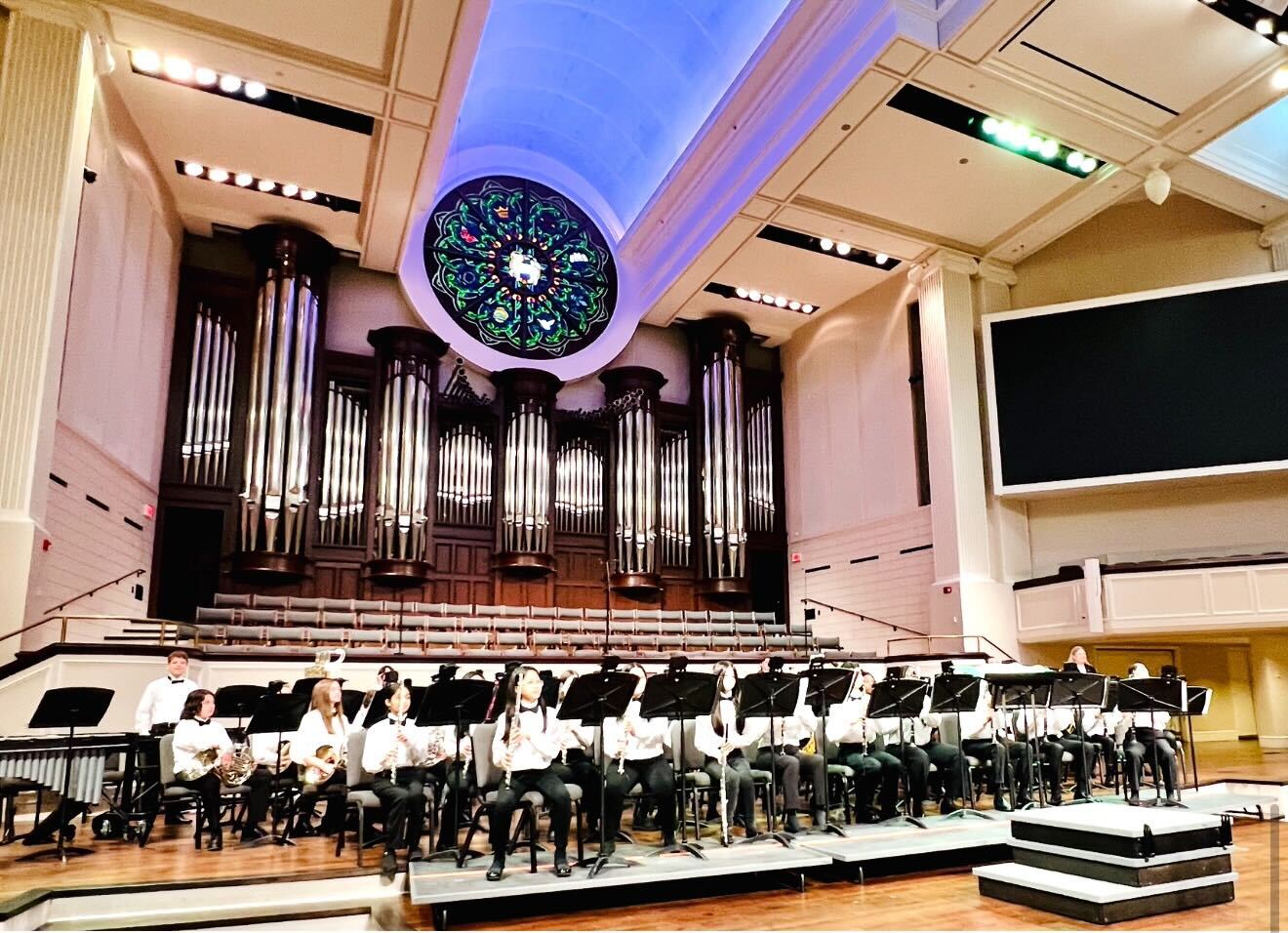
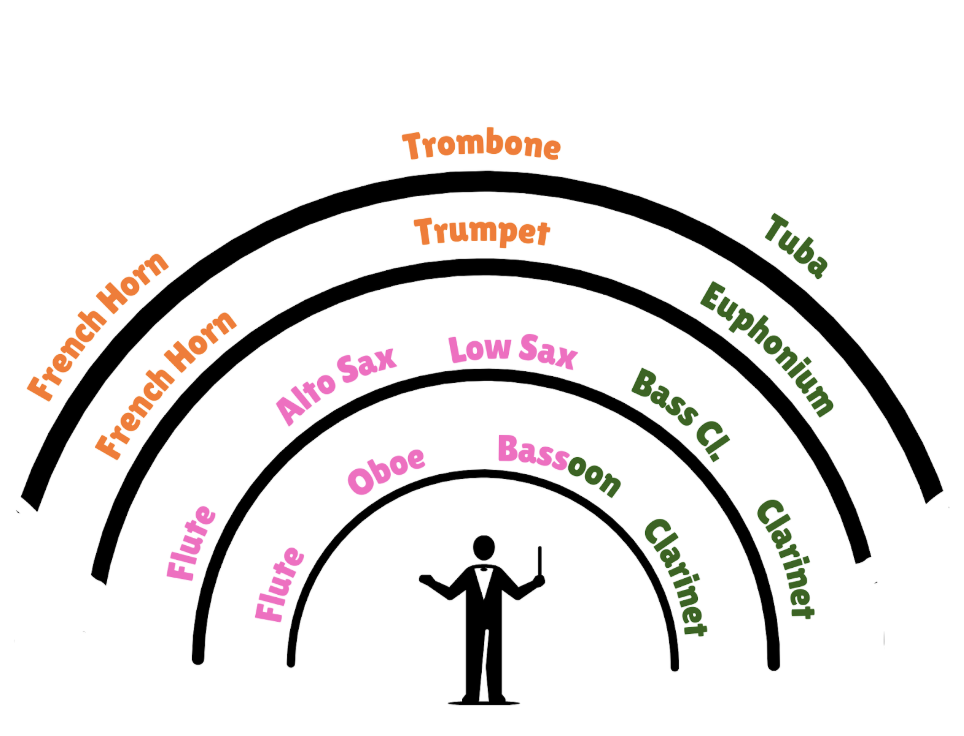
Band Nerd Confession: I love to sit in the Honor Band concerts and snap a photo of their set-up on stage! I find it incredibly interesting and strategic of how instruments are grouped and arranged on stage. A smart set-up can make your group sound incredibly mature. No two bands have the same make-up and numbers, so there is not one answer to this, but it is important to have some strategy to enhance the ensemble sound and balance. Discover what you like and what works for your group. I will alter this from year to year (and concert to concert) based on what I want to feature.
We establish color group assignments into 3 main families (give them a cute name) and seat them near each other. We try to establish this very early for listening and balance exercises in their pod. We isolate this a lot. Group 3 will have lots of vibrato pulsing practice! Group 1 - Clarinet, Bass Clarinet, Bassoon, Euphonium, Tuba Group 2 - Trumpet, Trombone, French Horn Group 3 - Flute, Oboe, Saxophone, Bassoon (they get to be in two groups)
Balance Points to Establish
- Woodwind to Brass - The woodwinds are the color, the brass are the power!
- Do not let the woodwinds overplay the brass. If the woodwinds can’t hear them, then they need to lower their volume level. A simple brass echoes woodwind exercise back and forth for 8 counts each can help establish their volumes in the room.
- Isolate woodwind and brass family sound. Can you hear all the instruments equally?
- To go further - continue to stack different pairings. Trumpet and Trombone, all double reeds, all people in certain octaves, etc.
- Isolation Groups
- Have 1st chairs / one on a part play for 8 counts, and then have the full band join and fit into their sound. “Sound like your first chair. Match their volume and energy.” Add the next person in the row, and on.
- Break the full group into 4-5 different mini-groups, with representatives from highs, middles and lows (and leaders and followers). This is a great way to hear individuals on their music throughout the year! Some groups create mini-bands based on the number of tuba players (i.e., If there are 5 tuba players, then there are 5 mini bands with 20% of the remaining band paired with each individual tuba).
How to apply that to the music you are performing through rehearsal strategies
Teach with the end in mind and know your score. We have all been guilty in our younger years of discovering hidden traps in music along with the students. What could have been cleaner if we would have taught the style better? What if we would have made better balance and volume choices right away in sectionals? What if we had practiced earlier not breathing on the bar line? The more familiar you are with how you want the music to sound stylistically, phrasing and balance wise, the more effective you can be with your rehearsal time.
Marking up the Music
So much rehearsal time can be saved if your score and the students’ music are clearly marked. The students need to be consistently held accountable for making and adhering to their markings.
- Find a way to make having a pencil on the stand a part of their daily supply routine. If you never give them reasons to use it, they will not make it a priority.
- Do you and your staff have an agreed upon way that all students will draw and make markings throughout your program? Do you use the same language when you talk about markings so that it is consistent, quick and efficient for everyone?
- Do you take the time to pre-mark some things in the music for them before you distribute their music to them? This is acceptable and appropriate depending on their age and the music. Don’t pre-mark everything for them - they do need to learn.
- Do you mark in your personal score things you tell them to mark in theirs?
- Even though you will be going slower tempos at the beginning, plan for articulation, style and phrasing for when the tempos increase. Adjustments can be made, but make sure the students know what the eventual goal is.
- Note lengths and style marking can vary in interpretation. Seek advice from trusted clinicians or more experienced directors if you are unsure how to interpret something. Whatever you decide, make sure it is implemented consistently.
- Train students to mark in balance points in regards to melody, melody-harmony, harmony, bass line. “Bring Out” “w/Tpt.” Maybe not everyone needs to play a personal fortissimo and dynamics need to be slashed out and adjusted.
- Vibrato instruments need vibrato (squiggle) marking above key notes.
Finding Clarity in the Music
So you’ve worked like crazy on your daily drill and fundamental techniques. How do you apply those concepts to band rehearsals to train your students to apply what they’ve learned?
- Playing lines of music on one note- Beyond the obvious help with alignment and style, the students can be trained to copy the resonance and presence of their best sound across all of the rhythms and styles required of them in a phrase. And, it doesn’t have to be concert F. It could be the key-center note, a chord, or any other helpful note (i.e., E below the staff on clarinet).
- Use isolation groups to hear phrases- Beyond the obvious groups you can identify in the music here, your mini-bands and color groups can help establish clarity and give fellow students a tone quality reference example within their sections. First chair students can play separately as well to be an even more mature representation of the part.
- Change dynamics as a practice technique. For example, play your busiest and most complex phrases of music with the student’s softest but best sound. Dynamics can increase incrementally as soon as you hear the interplay of the rhythms and harmonies as appropriate.
- Continue to reference how they sound in daily drill versus how it sounds in music. If there are daily drill exercises that you have crafted that directly apply to a phrase of music, then go right to that phrase of music and apply, don’t wait until later in your rehearsal.
- Remember- aligning rhythms and styles can also help with the clarity of your group. Some would argue that timing is the most important ensemble skill to build with your students so that all of those mature tone qualities you’ve been honing actually make it to the audience before being cancelled out! Exercises like counting, tapping your collarbone, tapping rhythms on two fingers and modeling on syllables are great ways for students to practice their alignment and rhythmic interplay. There are countless varieties of modeling exercises that you can come up with on your own as well to keep your rehearsal fresh and to model new practice techniques for your students to imitate in their own individual practice.
Parting Thoughts
It can feel daunting to build a vocabulary of feedback and exercises that help craft the result of clarity and transparency in your band sounds, but remember- you are the director, so you are the one who ultimately decides what that band sound is. Trust your ears and the ears of those around you to guide your decisions! Any band can be a good band if the students sound characteristic AND you can hear all of those characteristic sounds simultaneously.