

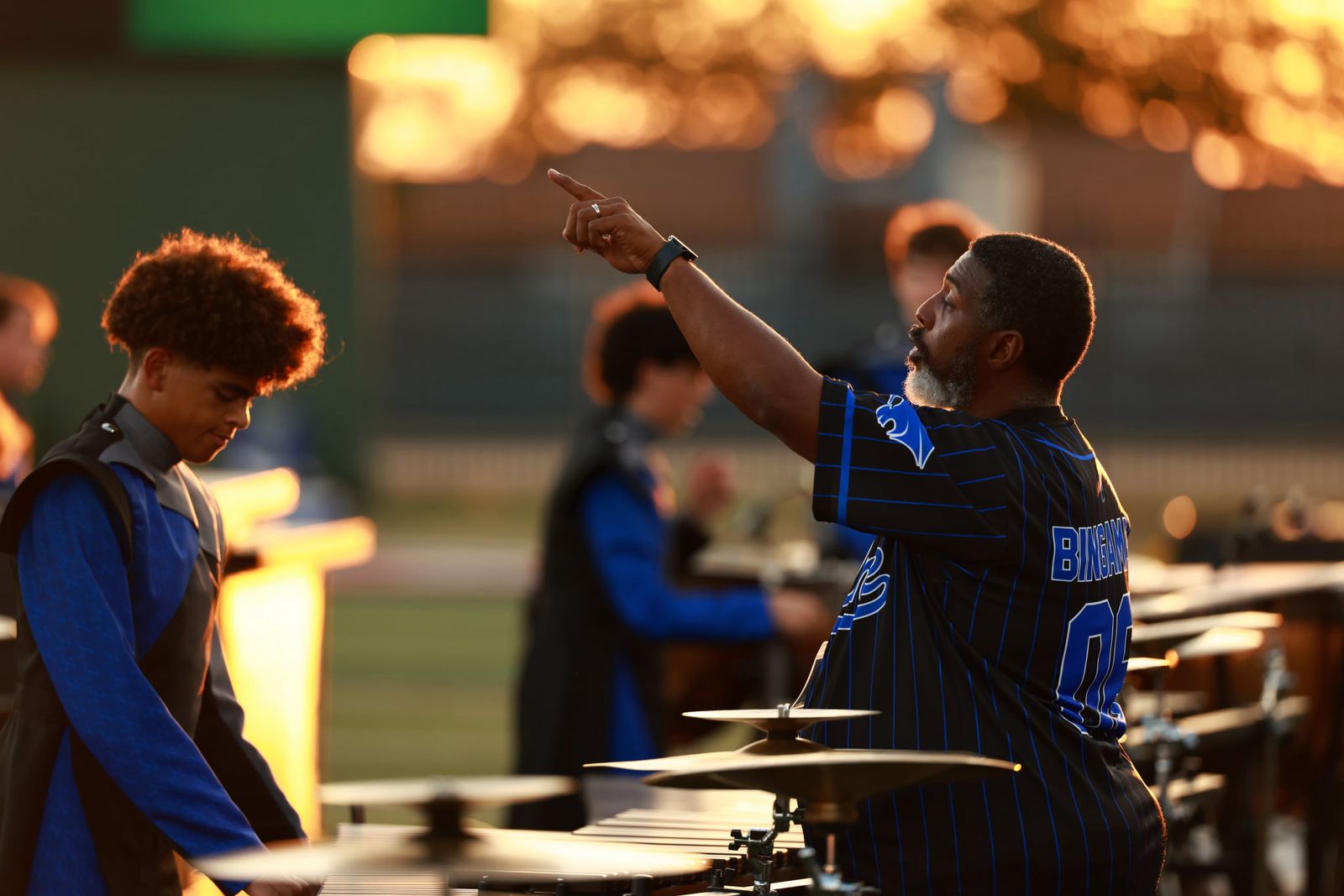
A student misses the same entrance for the third time. I stop, explain what happened, give the correction, and the next time through it’s better. From the outside, that looks like good teaching. But did the student learn to hear the problem, or did I just solve it for them?
As music educators, we get very good at hearing and seeing problems. We notice when a student is rushing, when an articulation doesn’t match, when a phrase loses direction, when the ensemble balance shifts away from the primary voice, or when the quality of sound changes from one register to another.
As a percussionist, I notice when one hand is playing from a different height than the other, when a stroke gets less efficient as the dynamic changes, when a mallet keeps missing the best playing zone, or when a student understands the rhythm but isn’t centered on the pulse.
Because we spot these problems so quickly, our natural response is to tell students exactly what’s wrong. Sometimes that’s necessary. Students need information, vocabulary, models, and clear expectations. But if we always supply the awareness, the diagnosis, and the solution, students can become very good at following instructions without becoming equally good at evaluating their own playing.
Students cannot correct what they cannot perceive.
Awareness Comes Before Correction
Before students can consistently change a behavior, they have to become aware of what’s happening. Take something as simple as playing in time. A student may understand the rhythm, count it correctly, and know the subdivision, yet still play slightly ahead of the pulse or let the tempo drift.
We can say, “You’re rushing,” and that gives the student useful information. But what happens on the next repetition? Or tomorrow? Or when the student is concentrating on notes, dynamics, style, or someone else’s part? If students never learn to perceive their own relationship to the pulse, the correction stays dependent on the teacher.
The same is true for a percussionist who stops the stick as it comes off the head (the disengagement) instead of letting the rebound carry it naturally back up (the recovery). I can say, “Let the stick rebound,” and the next repetition may improve. But if the student never learns to feel the difference between allowing the rebound and holding it back, the correction can disappear as soon as their attention moves elsewhere.
A different approach starts with a question: “What did you feel happen to the stick after contact?” or “Did the stick move naturally into recovery, or did you stop it?” When working on time, it might be “Where did you feel yourself in relation to the beat?” The teacher is still guiding the process, but now the student has to listen, compare, and notice.
Questions Transfer Responsibility
Teachers sometimes skip questions because giving the answer is faster, and in the short term, it usually is. But efficiency and learning aren’t always the same thing. A well-timed question pulls students into the diagnosis instead of handing it to them. Instead of saying, “The trumpets are too loud,” we might ask, “Who has the primary musical line?” Then, “Can you still hear it clearly?” Finally, “What needs to change in the balance?”
Instead of “That note is out of tune,” try “What do you hear happening to the pitch?” With a percussionist, instead of immediately saying, “Your doubles are uneven,” we might ask, “Do the two notes sound equally spaced?” Then, “Is the second note as full as the first?” That moves the student beyond knowing that a double-stroke roll is uneven and toward perceiving why.
The same goes for full ensemble rehearsal. If students are always waiting for the conductor to tell them what was out of balance, out of tune, or out of time, they may become responsive ensemble members without ever becoming independently aware musicians.
Over time, students should learn to notice the result, identify the problem, consider the cause, make an adjustment, and evaluate what happened. That can’t happen if we give the answer so quickly that they never have to notice anything themselves. Telling might fix this repetition, but questioning builds the student who fixes the next one.
Awareness and Intention Work Together
Awareness alone isn’t enough, though. A student may recognize that something went wrong and still have no clear idea what to do next. That’s where intention comes in. I often think of learning as a simple cycle. The student decides what they’re trying to accomplish, performs the action, notices what happened, makes an adjustment, and goes again. In simpler terms: decide, play, notice, change, repeat.
Repetition is powerful, but it doesn’t automatically produce improvement. If a student keeps playing with unstable time, poor tone, inconsistent articulation, ineffective balance, or inefficient motion without recognizing it, the repetition can actually strengthen the problem.
Percussionists see this clearly in technical work. Eight-on-a-hand, double stops, scales, rudiments, and timing exercises are all useful, but only if the student is aware of what the repetition is reinforcing. Repeating an uneven stroke path, poor rebound, an inconsistent playing zone, or an unstable pulse just makes that behavior more familiar.
Every repetition teaches something. Our job is to control what it teaches.
The Goal Is Independence
In the earliest stages of learning, the teacher provides almost everything: the standard, the language, the diagnosis, the correction, and the evaluation. That’s often exactly what beginners need. But the relationship should change over time.
At first, the teacher identifies the problem and provides the solution. Later, the teacher might identify the problem while the student helps find the solution. Eventually, the student identifies the problem, chooses a solution, and evaluates the result without us. The goal is to hand that responsibility over completely by helping students build their own internal feedback system.
Following a correction once is compliance. Applying it later without prompting is learning. Recognizing the need for correction independently is musicianship.
We spend a lot of time teaching students what to play: notes, rhythms, fingerings, articulations, dynamics, balance, phrasing, and style. In percussion, add stroke types, rebound, sound production, playing zones, timing, and coordination. We should also teach students how to evaluate what they’re doing while they play.
Awareness, self-diagnosis, and setting an intention before the next repetition are all skills. When we develop them deliberately, students get better at practicing, rehearsing, and growing without a teacher supplying every answer.
Try This in Your Next Rehearsal
Before you give the next correction, ask one question that requires the student or ensemble to identify what happened. Then ask what should change on the next repetition. You don’t have to give up direct instruction; the idea is to gradually hand some of the listening and diagnosis back to your students. A few questions to start with:
- Where did you feel yourself in relation to the beat?
- Who has the primary musical line? Can you still hear it clearly?
- What do you hear happening to the pitch?
- What did you feel happen to the stick after contact?
- Do the two notes sound equally spaced? Is the second note as full as the first?
Questions like these are how we develop musicians who keep listening, adjusting, and growing when we’re not in the room.